
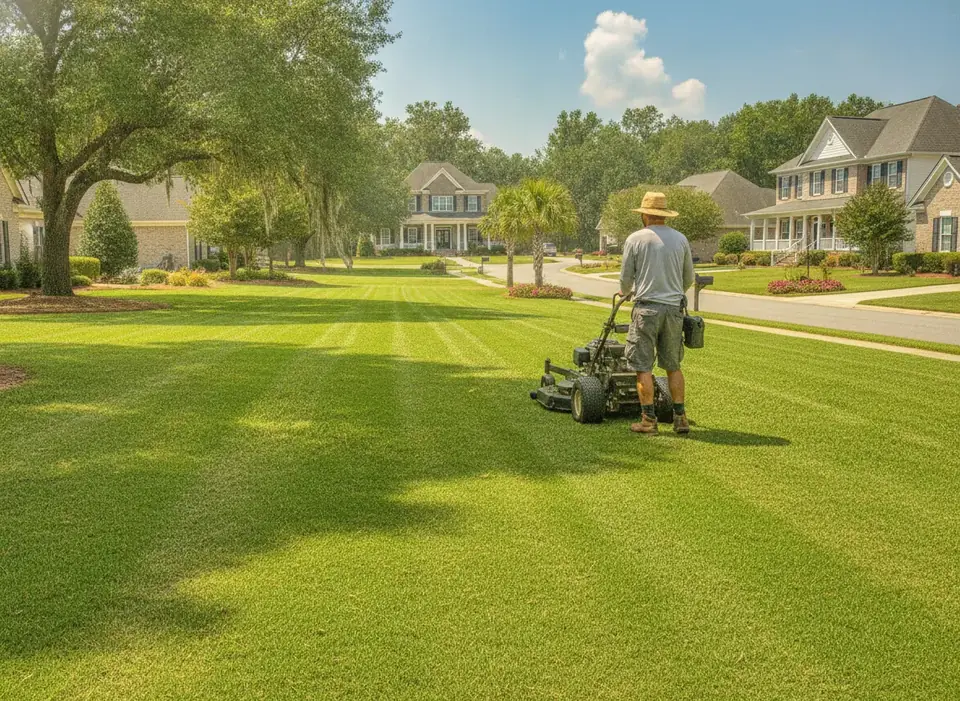
Centipede grass in coastal Georgia does well with less: about 1 pound of nitrogen per 1,000 sq ft per year (up to 2 pounds on sandy, high-rainfall soils), split into small doses after the soil warms to 65 °F, no fall fertilizer, mowing at 1 to 2 inches, and about an inch of water a week. Most centipede problems in Savannah come from too much fertilizer, lime or water, not too little, according to the University of Georgia's Circular 1003, Centipedegrass Decline.
Why centipede suits the Savannah area
Centipede is one of the four main warm-season lawns on the Georgia coast, along with St. Augustine, zoysia and bermuda. It likes acidic soil, with a pH of about 5.0 to 6.0 (UGA), and many native soils in Bryan and Chatham Counties are strongly acid. It grows slowly, needs little fertilizer and is forgiving about mowing. The trade-off is that it is easy to kill with kindness. If you are still deciding on a grass, start with our guide to the best grass for Savannah lawns.
A centipede calendar for coastal Georgia
Savannah's median last spring freeze is March 2 (in 1 year in 10 it comes after March 25), and the median first fall freeze is November 30, per NOAA's 1991–2020 normals (NOAA). That frames the year:
Mid-February
Apply crabgrass and goosegrass pre-emergent before soil reaches 55 °F. In south Georgia that is about February 15 to March 15 (UGA Extension); on the coast, aim for mid-February. Check soil temperatures at georgiaweather.net.
Spring green-up
Hold off on fertilizer until the 4-inch soil temperature stays at 65 °F and the lawn has greened up. Feeding dormant centipede mostly feeds weeds.
Late spring to mid-summer
Fertilize in small doses, mow regularly and water about an inch a week, counting rain.
Fall and winter
No fall fertilizer. South Georgia extension advice is to feed after green-up and in mid-summer only (UGA Extension). Let the lawn go dormant after the late-November freezes.
Fertilizing centipede: less is more
UGA says one pound of actual nitrogen per 1,000 sq ft per year "is ample" for most established centipede lawns. On sandy, high-rainfall sites, which describes many coastal yards, up to 2 pounds is acceptable because nitrogen leaches through sand quickly. Rather than one heavy feeding, split the year's total into three applications of about 1/3 pound or four of about 1/4 pound.
Over-fertilizing is linked to centipede decline: a lawn that greens up in spring, then thins, yellows and dies back in patches. Two other habits make it worse:
- Unneeded lime. Above a pH of 6.0, iron becomes less available and centipede yellows. Add lime only if a soil test calls for it.
- Too much phosphorus. High phosphorus also ties up iron. Again, follow a soil test.
- Fall feeding. Nitrogen late in the year pushes soft growth into winter.
Many lawn programs sold as "weed and feed" combine fertilizer with herbicide. Read the label to be sure the product is safe for centipede, and count its nitrogen toward the yearly total.
Mowing height
UGA Extension in coastal Glynn County lists centipede at 1 to 2 inches (UGA Glynn County), and UGA Circular 1003 gives 1.0 to 1.5 inches. Raise the deck about half an inch in the hottest weather, and never remove more than one-third of the blade in one mowing (UGA). Savannah averages 80.5 days a year at or above 90 °F, so a slightly taller summer cut helps the grass shade its own roots. Sharp blades matter too: a torn tip browns and invites disease.
Watering centipede on Savannah's schedule
Established centipede needs about 1 inch of water a week from rain plus irrigation, applied so it wets the soil 5 to 7 inches deep, early in the morning. That fits Savannah's three-day schedule easily: one or two deep waterings before 10 a.m. on your allowed days. Summer usually supplies much of it, since June through August are the wettest months. See the full Savannah watering schedule for your days and the exemptions for new sod.
Shallow, daily watering produces shallow roots and wet thatch, which favors fungus and weeds.
Weeds: crabgrass and dollarweed
A thick, properly fed centipede lawn is the first defense against weeds. The mid-February pre-emergent stops most crabgrass and goosegrass. Dollarweed, the round-leaved weed that loves wet spots, is a moisture problem first: UGA advises fixing irrigation and drainage before reaching for an herbicide, and notes that complete eradication is "often unattainable" (UGA Extension). Centipede is sensitive to some herbicides, so always check that a product's label lists centipede.
If you hire someone to apply weed control: in Georgia, a business that applies pesticides — including weed killers, weed-and-feed, insect, fire ant or mosquito treatments — to someone else's property for a fee needs a Pesticide Contractor License from the Georgia Department of Agriculture, with a certified commercial applicator on staff (O.C.G.A. § 2-7-99). Lawn and shrub work falls under applicator Category 24 (Ornamental and Turf); mosquito control is Category 41. Ask for the license number and check it with the Georgia Department of Agriculture. This is general information, not legal advice. Our Georgia lawn care license rules post goes deeper.
Brown patches: decline, disease or bugs?
- Patches that thin and yellow in late spring or summer after a season of heavy feeding or liming point toward centipede decline.
- Brown rings in fall or spring while soils are cool and wet are a classic sign of large patch, which hits centipede, St. Augustine and zoysia. Avoid nitrogen when the soil is below 70 °F. See our large patch guide.
- Mounds and stings mean fire ants; see fire ant control in Savannah.
When in doubt, UGA Extension's county offices can help diagnose a sample.
Renovating a thin lawn
If decline has gone too far, the fix is usually to correct the cause (feeding, lime, drainage) and then re-sod bare areas. Published cost guides put installed sod at about $1–$3 per sq ft and core aeration at about $71–$190 a visit (typical ranges from published cost guides (2026) — estimates, not quotes). More ranges are on our landscaping prices page.
Compare local lawn care quotes
We connect Savannah-area homeowners with independent local lawn care, landscaping and tree companies for free, no-obligation quotes. The company you choose quotes, contracts and does the work directly with you. Local companies that offer weed control and fertilization, lawn mowing or sod installation can put a centipede lawn on a low-input program. Ask them how much nitrogen they apply each year and when. Request a free quote to compare.