
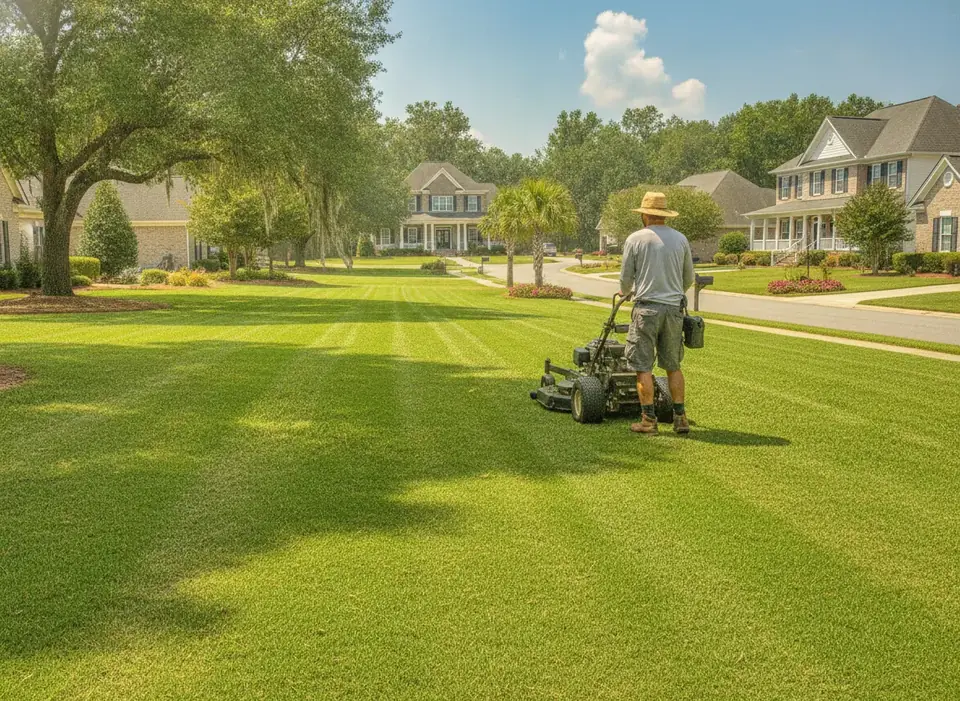
Winter lawn care in Savannah is mostly about doing less, at the right time. Centipede, St. Augustine, zoysia and bermuda are warm-season grasses, so they stop growing and turn brown after the first hard freezes, which arrive around the end of November in a typical year. From then until green-up in March the job is to keep leaves off the grass, mow only when something is growing, water just enough in a dry spell and hold the fertilizer.
When Savannah lawns go dormant
Savannah does not get a long winter, but it gets enough cold to shut warm-season grass down. NOAA's 1991–2020 normals for Savannah/Hilton Head International Airport put the median first fall freeze on November 30. In one year in ten it waits until after December 28. The December average low is 42.6 °F and January's is 40.0 °F, with about 21 nights a year at or below freezing. Warm-season grasses generally go dormant and brown after those late-November and December freezes and stay that way until the soil warms in spring. The median last spring freeze is March 2.
A brown lawn in January is normal here, not a sign of disease or drought; the crowns and runners are alive, the blades are not. Which grass you have changes how early it browns and how fast it comes back. Our guide to the best grass for Savannah lawns compares centipede, St. Augustine, zoysia and bermuda for sun, shade and upkeep.
The last mow of the season
There is no special “winterizing” cut. Keep mowing at the normal height for your grass as long as it is growing, then stop when it goes dormant. UGA Extension in Glynn County lists these heights: common bermuda 1–2 inches, hybrid bermuda 1–1.5 inches, centipede 1–2 inches (UGA Circular 1003 gives 1 to 1.5 inches), St. Augustine 2–3 inches and zoysia 1–2 inches. The one rule that matters more than the number is never to remove more than one-third of the leaf in a single mowing.
Two mistakes show up every November: scalping the lawn low “for the winter,” which strips leaf tissue and exposes the crowns to cold, and letting it grow tall and matted under leaves, where fungus settles in. A normal-height mow with the clippings mulched is the right last cut. After dormancy, an occasional pass is a tidy-up for leaves and winter weeds, not a cut.
Leaves, pine needles and pine straw
Savannah yards sit under live oaks, pines, pecans and magnolias, and a dormant lawn buried under leaves for weeks comes back thin in spring. Rake, blow or mulch-mow leaves off before they mat down; a thin chopped layer feeds the soil, a wet blanket smothers it. Winter is also when a fresh layer of pine straw goes down around shrubs and trees.
If it is more than a weekend's work, companies that offer yard cleanup in Savannah quote leaf and debris jobs by the visit. Published cost guides (2026) put a cleanup at about $143–$380 per visit, with small leaf jobs around $76–$127; those are estimates, not quotes. Pine straw installation has no reliable published local average, so get two or three quotes for that.
Watering days do not change in winter. The City of Savannah's outdoor watering schedule is year-round: no irrigation between 10 a.m. and 4 p.m., no watering on Fridays, even-numbered addresses on Monday, Wednesday and Saturday and odd-numbered addresses on Tuesday, Thursday and Sunday. Unincorporated Chatham County and Tybee Island follow the same pattern. Details and the state exemptions are in our Savannah watering schedule guide.
Watering in a dry Savannah winter
Late fall is the driest time of year here. The NOAA normals show November at 2.39 inches of rain, the lowest month, with February next at 2.80 inches; December (3.21) and January (3.28) are not much wetter, compared with 6.65 inches in June. A dormant lawn needs far less than the roughly one inch a week UGA recommends for growing turf, but on sandy coastal soil it can still dry out during a two or three week stretch without rain, and that stress shows up as slow green-up in March.
Water deeply but rarely in winter: a long soak on an assigned day during an extended dry spell, rather than short daily runs. Winter is also a good time to check sprinkler heads, leaks and the controller schedule; companies that offer irrigation repair in Savannah quote that work. As of our last check, Georgia EPD had a statewide Drought Response Level 1 in place (declared April 27, 2026), which does not change the watering window; check epd.georgia.gov for the current level.
Fertilizer, weeds and disease in the off-season
Hold the fertilizer. South Georgia extension guidance for centipede is to feed after green-up and in mid-summer, with no fall feeding. For all the coastal grasses, UGA advises against nitrogen when soil is below 70 °F, because it feeds large patch, the fungus that leaves brown rings in zoysia, St. Augustine and centipede. If rings form after a wet, cool spell, our large patch guide covers what helps.
Winter weeds show up green against a brown lawn, and the only lasting fix for dollarweed is better drainage. The bigger date on the calendar is pre-emergent for crabgrass and goosegrass, which UGA says should go down before soil temperatures reach 55 °F, about mid-February on the coast. We cover the window and what it does and does not do in pre-emergent timing for Savannah.
What a lawn service does in December, January and February
A typical winter program from a local company looks like this:
- Mowing on a reduced schedule. Weekly visits usually become every other week or on-call once the lawn is dormant. Ask whether the per-visit price changes for a visit that is only leaf blowing. Published cost guides put mowing at about $48–$143 per visit.
- Leaf and debris cleanup. Clearing turf, beds and walks, with haul-away. The main winter job on wooded lots.
- Bed work. Cutting back dead perennials, edging and a fresh layer of pine straw or mulch.
- Tree work. Hurricane season ends November 30, and the dormant months are when many homeowners schedule trimming and removal of trees damaged over the summer.
- February pre-emergent. The first treatment of the new year, timed to soil temperature. A company that applies it for a fee needs a Georgia Pesticide Contractor License; our license rules guide explains what to check.
Winter is also the time to line up a provider for spring, before lawn mowing companies in Savannah fill their March routes. Ask for a written quote that states visit frequency by season and what is extra. For typical ranges, see our Savannah lawn care and landscaping prices.
Frequently asked questions
Should I keep mowing my Savannah lawn in winter?
Mow as long as the grass is still growing, which on the coast can run into December in a mild year. Keep the blade at the normal height for your grass and never take off more than a third of the leaf. Once the lawn is brown and dormant, mowing drops to an occasional pass to tidy leaves and winter weeds.
Does a dormant lawn in Savannah need water?
Much less than a growing one, but not zero. November is the driest month of the year here at 2.39 inches, and a dormant lawn on sandy soil can still dry out during a long rainless stretch. An occasional deep watering on your assigned day is usually enough. The City of Savannah schedule applies year-round, so watering days and hours do not change in winter.
Should I fertilize my lawn in the fall or winter in Savannah?
No. South Georgia extension guidance for centipede is to feed after spring green-up and in mid-summer, with no fall feeding, and UGA advises against nitrogen when soil is below 70 °F because it feeds large patch disease. Hold fertilizer until the lawn has greened up in spring and the 4-inch soil temperature holds around 65 °F.
What does a lawn service do in Savannah in December, January and February?
Mostly cleanup and prep rather than mowing: leaf and debris removal, bed cleanup and fresh pine straw, cutting back dead growth, checking irrigation and, in February, putting down pre-emergent before soil reaches 55 °F. Many companies switch from weekly visits to every other week or on-call visits in winter; ask how their schedule and pricing change.
Get quotes for the off-season
We connect Savannah-area homeowners with independent local lawn care, landscaping and tree companies for free, no-obligation quotes. The company you choose quotes, contracts and does the work directly with you. Request a free quote and compare two or three before you decide.